Thursday, August 4, 2011

And From a Proud Tower in the Town...

A lovely profile of Barbara Tuchman in the Washington Post:

"She does not like being called an 'amateur' by all the 'professionals' who have graduate training, advanced degrees, and university positions. She prefers, she said in a 1981 collection of essays covering her career, to recognize the difference between them and her 'by distinguishing between academics and independents, or between scholars and writers, rather than between professionals and amateurs.' She may not have a Ph.D., but she is as much of a pro as the professors are, and rather more so if making a living by your work is any criterion of being professional. She can communicate with a willing readership, which is more than the professors can do. . . . They really do not know how 'to capture and hold the interest of an audience.' "


More

Monday, July 18, 2011

Late Communist Architecture

 (Georgian Ministry of Roads, completed in 1975)

I think this should belie the claim that late Soviet and Eastern Block culture was lacking in innovation. These collections of images - 25 WWII memorials built under Tito in the former Yugoslavia and images from the recently published book by French photographer Fredric Chaubin documenting avant-garde late Soviet architecture provide an interesting look at Eastern European architectural developments in the 70s and 80s.
(Palace of Ceremonies, Georgia, 1985)

Friday, June 17, 2011

History, Modernity, and the Masses

"And now back to our first statement: modern man suffers from a weakened personality. Just as the Roman in the time of the Caesars became un-Roman with regard to the area of the earth standing at his disposal, as he lost himself among the foreign things streaming in and degenerated with the cosmopolitan carnival of gods, customs, and arts, so matters must go with the modern person who continually allows his historical artists to prepare the celebration of a world market fair. He has become a spectator, enjoying himself and wandering around, converted into a condition in which even great wars and huge revolutions are hardly able to change anything momentarily. The war has not yet ended, and already it is transformed on printed paper a hundred thousand times over; it is already being promoted as the newest stimulant for the exhausted palate of those greedy for history."
- Friedrich Nietzsche, Vom Nutzen und Nachteile der Historie für das Leben/The Use and Abuse of History for Life (1871)


"The war, the Revolution in Russia and the misery of the whole world appear to me like deluge of (Flut) evil, a flood. The war has opened the sluices of chaos. The external and temporary measures of human existence are collapsing. The events of history are no longer borne by individuals, but by the masses. We are pushed, forced, brushed aside. We are suffering from History."

-Franz Kafka to Gustav Janouch,
Das Kafkabuch (around 1920) (translation mine)


"Since the invention of the steam engine, the world has been permanently in an abnormal state; the wars and revolutions are just the visible expressions of this state." -Ivanov to Rubashov

"The discovery of the steam engine started a period of rapid objective progress, and, consequently, of equally rapid subjective political retrogression. The industrial era is still young in history, the discrepancy is still great between its extremely complicated economic structure and the masses' understanding of it. Thus it is comprehensible that the relative political maturity of the nations in the first half of the twentieth century is less than it was 200 B.C. or at the end of the feudal epoch."

-Rubashov,
Darkness at Noon (1941)

Thursday, May 19, 2011

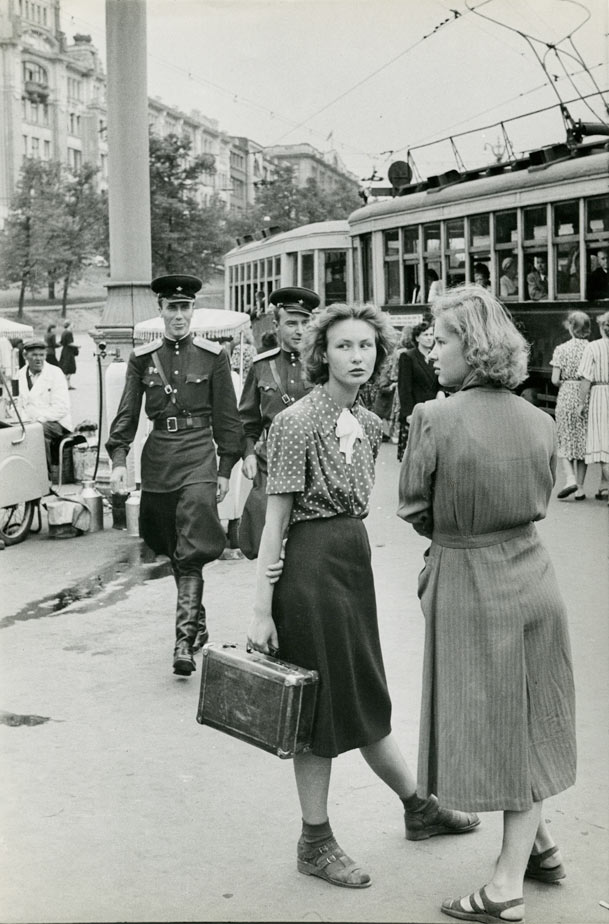
Moscow 1954


Henri Cartier-Bresson was a French photographer considered to be the father of modern photojournalism, an early adopter of 35 mm format, and the master of candid photography. He helped develop the "street photography" style that has influenced generations of photographers that followed. These pictures were taken in the first year of the post-Stalin USSR.

Monday, October 25, 2010

Photo collections of years gone by


Three great photo collections: The Library of Congress has an exhibition on the thousands of color photos that were taken by Sergei Gorskii on assignment from the Czar, capturing everything from village Jewish life um Jahrhundertswende to the mountains and peoples of Central Asia.


A controversial exhibition of color photos shot in occupied Paris for German propaganda.


Photographs taken across the Soviet Union in the late 1970s for National Geographic.


A weblog of unpublished photographs from fin de siècle American life.

Monday, June 28, 2010

Last rites for Stalinism?


The removal of Stalin's statue from the Man of Steel's hometown in Gorii, Georgia, on June 25th, 2010, was done unanounced in the dead of night, without the pomp, ceremony, and tank lines that typically commemorate the death of a generalissimo. The circumstances of the statue's removal are eerily similar to those of Nicolai Salmanovitch Rubashov's banal execution in Arthur Koestler's fictional masterpiece Darkness at Noon. At the end of the novel, Nikolai, who was also once a great hero of Soviet Russia and leading member of the Bolshevik party, is hastily executed in a dark cellar at the bottom of a Soviet prison, a death wholly unfitting for a once glorified leader and revolutionary hero, his death symbolizing the destruction of the original revolutionary class and the triumph of Stalinism. And so this statue's removal, combined with Russian leadership's recent stinging rejection of Stalin and the canceling of plans in Moscow to hang Stalin posters during Victory day, may also represent a final bullet in the head to the once-triumphant Stalinism, the revenge of the original revolutionary class far after the death of revolution. Yet ideas seem far harder to kill, as the recent unveiling of a Stalin statue by communists in south-eastern Ukraine under heavy police protection, carried out against the wishes of a majority of the population demonstrates. It would be difficult to argue, however, that the general picture of Stalinism is one in steady decline.
The brilliance of Darkness at Noon is that it went beyond Orwell's 1984 and Huxley's Brave New World is that the novel doesn't attempt to present a completely fictional totalitarian state dreamed up by British intellectuals, but instead plumbs the mental depths of one of history's most infamous totalitarian movements through an author who had witnessed Stalin's state and had taken a journey from avid Bolschevik to defender of democracy. By the end of the novel, as the aging revolutionary Nikolai collapses under the interrogations of the new revolutionary elite, he completes his own interrogation of the ideas behind Stalinism and the shocking logic behind the show trials, embodied in the cruel logic of "the ends justify the means" and confesses to "having placed the idea of man above the idea of mankind." But what were the ends that were ultimately reached through Stalinism even worth these means?
The removal of Stalin's statue in Gori itself was justified by the government in that it was a symbol of Russian imperialism, which a claim likely rooted in events immediately following the end of the Revolution. Stalin's support of the overthrow of the newly-independent Georgian government in 1921 and the immediate Sovietization of the country over the objections of other Bolschevik leaders, along with his deportation of Cacusian peoples to Siberia during WW2, didn't stabilize the Caucasian region, but created a time bomb in the USSR that continues sporadically exploding to this day.
The Bolshevik revolution didn't spread after the "temporary set-back" of 30s European Fascism and the eventual victory of the Soviet Union in eastern Europe, but simply created a series of unwilling sattelite states, and the Baltic states, so prized by Stalin, became the Achilles heal of the USSR. A mere ten years after Uncle Joe's death, the Soviet economy began it's steady, systematic decline. By this time in the mid-sixties, radical student movements and 3rd-world liberation movements were increasingly turning to Maoist China, not the Soviet Union, for their models of revolution (the assassination of a Soviet minister by French Maoist students in Godard's La Chinoise is a perfect example of this shift in Western leftist Weltanschauung). From then on it was all downhill, by the arrival of Gorbachev it was too late.
Rubashov tells his interrogators towards the end of his trial that "it would be more in accordance with our ideas to tell people the truth," his interrogator responds "whether Jesus spoke the truth or not, when he asserted that he was the son of God and of a virgin, is of no interest to any sensible person. It is said to be symbolical, but the peasants take it literally. We have the same right to invent useful symbols which the peasants take literally." Yet once the symbol dies without a promise for eternal life, the whole farce unravels.